Introducing Macaron-V1.1 and Mint Recursive
- 分类
- —
- 发布
- 主题
- —
Macaron-V1.1 is a 752B-parameter agent model post-trained from GLM-5.3, with Mint Recursive enabling faster experience-driven training and evaluation.

Today, we are releasing Macaron-V1.1, a 752B-parameter agent model post-trained from GLM-5.3. It combines a 744B base model with four 2B LoRA specialists for Chat, Agent, Coding, and Generative UI.
Building on Macaron-V1, V1.1 upgrades the base from GLM-5.2 to GLM-5.3. Using Mint Recursive, our serverless training and inference platform, we completed the iteration from Macaron-V1 to Macaron-V1.1 in two weeks.
Updates and Evaluation
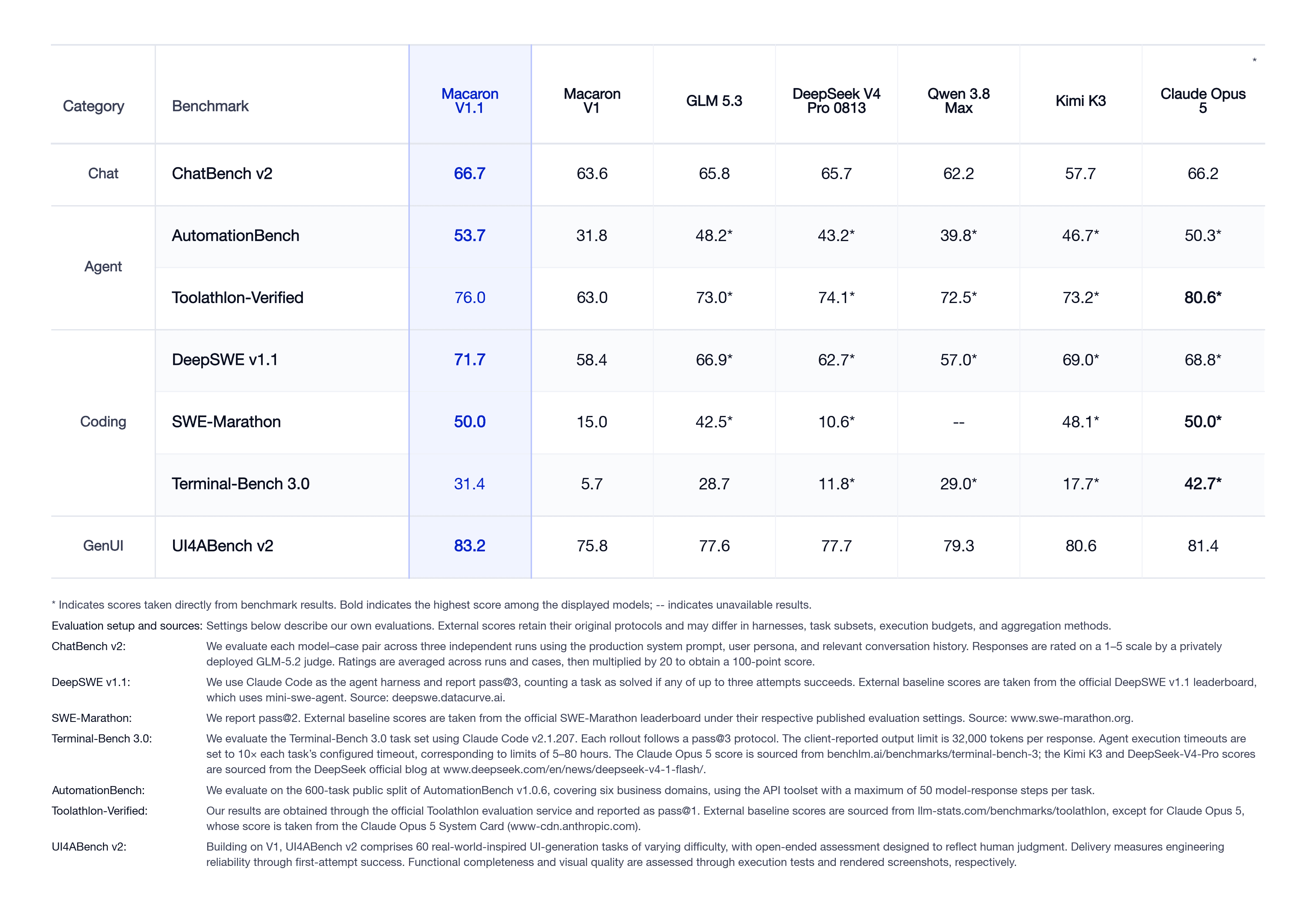
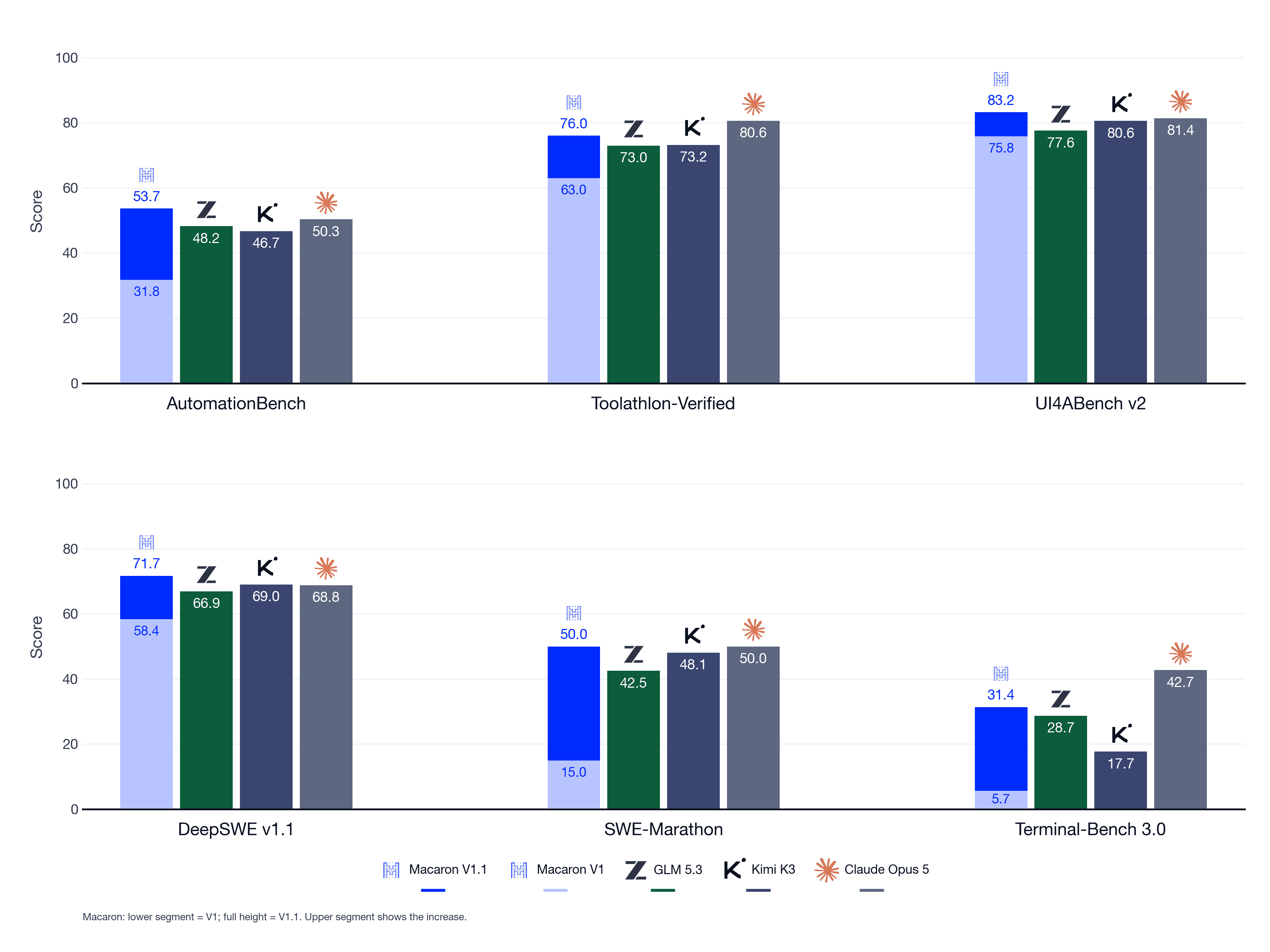
Long-horizon coding. V1.1 reduces the number of steps needed to complete extended coding tasks, helping the agent reach a verified result sooner with fewer tokens. The focus is on standardizing SWE trajectories into a five-stage workflow: reproduction, localization, editing, validation, and recovery. Applying this structure at the data level reduces low-relevance exploration rounds. V1.1 shows strong performance on DeepSWE and SWE Marathon.
Complex office tasks. We improved the model's judgment about when and how to use tools, with particular attention to avoiding unnecessary or inappropriate actions. In workflows involving documents, messages, and business systems, the model needs to recognize which tool to use, when to use it, and when to hold back. V1.1 is better at completing these tasks while staying within the user's intent and authorization.
We also expanded ChatBench and UI4A-Bench with more real-world cases, bringing both to V2.
Mint Recursive
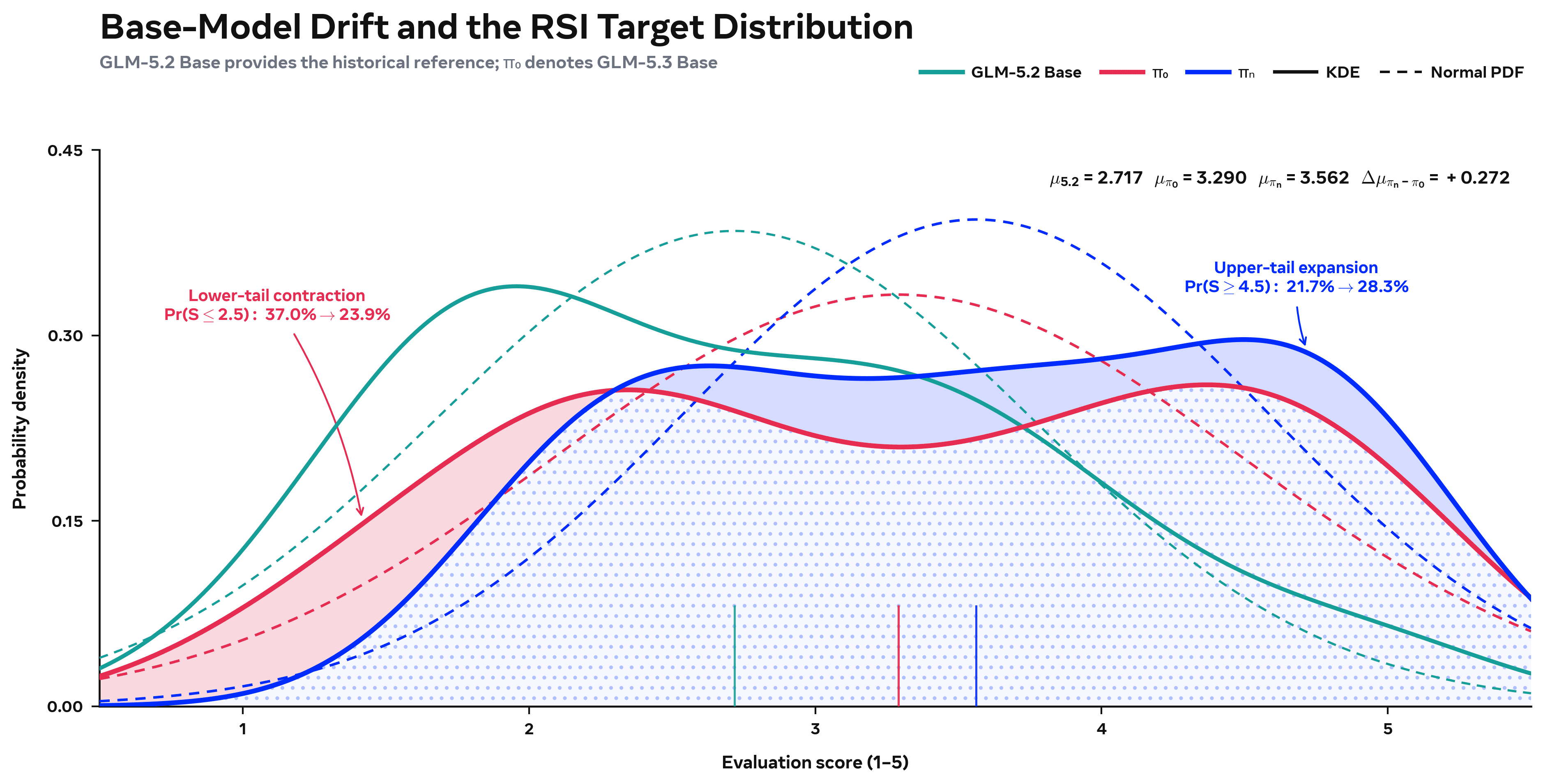
Macaron V1.1 is trained on Mint Recursive, Mind Lab's serverless and automated model training platform. We use it to prepare training data, run experiments, evaluate checkpoints, and deploy new versions within a single workflow. Each round gathers new experience that helps us identify the next capability gap and update the data and training configuration for the following run.
Case Studies: Chat and UI4A
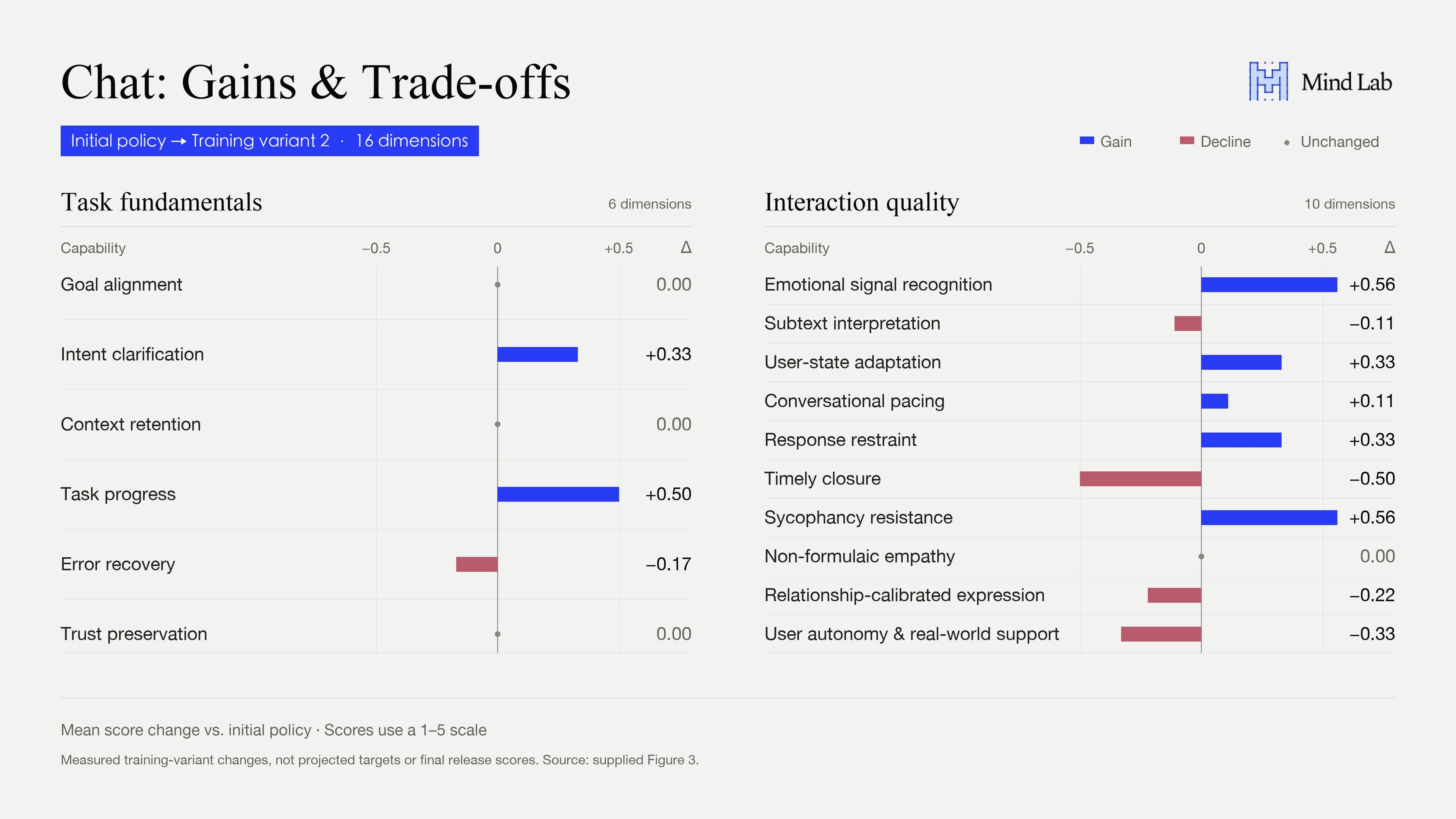
Chat. We used Mint Recursive to connect capability diagnosis, targeted data updates, and training. In one measured iteration, the second variant of the next training round improved task progress by 0.50 points, and emotional signal recognition and resistance to sycophancy by 0.56 points each, relative to the initial policy on a 1-5 scale. Timely closure declined by 0.50 points; such regressions informed the next round of data selection. The figures show all 16 dimensions from this experiment.
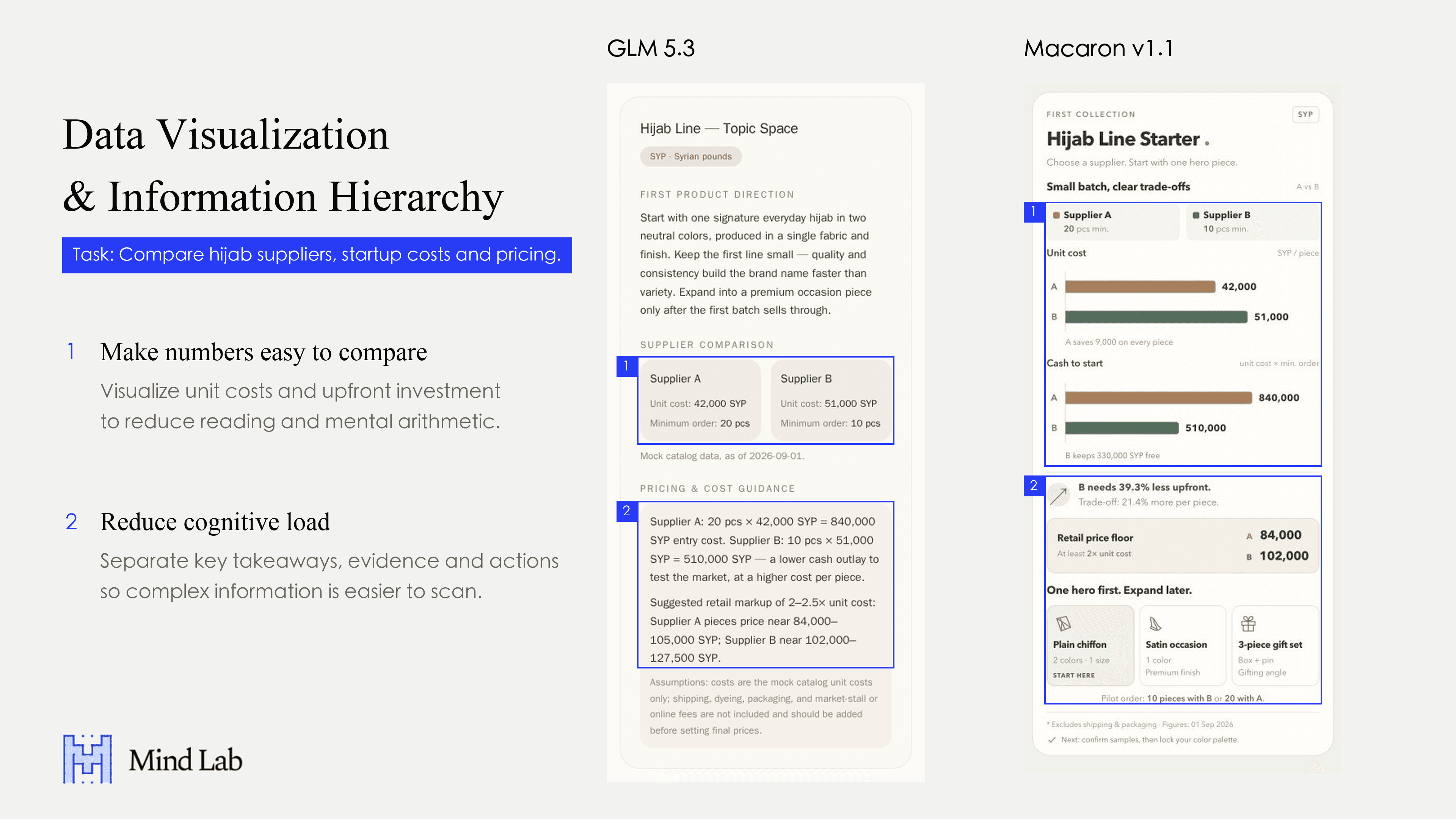
UI4A. We applied the same training workflow to delivery failures, interaction issues, and unclear information hierarchy, using these findings to select training examples and evaluate the updated model on the same tasks. Across 60 tasks, first-attempt delivery success rose from 71.67% (43/60) for GLM-5.3 to 96.67% (58/60) for Macaron-V1.1, a 25-point gain. Tasks requiring a retry fell from 17 to 2. The example below shows how the same supplier-comparison task gained clearer charts and information hierarchy.
How to Access
Open weights. Find our released model weights and model cards in the Macaron-V1 collection on Hugging Face.
Official API. For hosted inference, visit Mint Recursive at mint.macaron.im for overseas users or mintcn.macaron.xin for users in mainland China. See the platform documentation for available model IDs, pricing, and rate limits.