
Deep Principle Hydrogen-1: Post-Training GLM5.3 for Scientific Discovery | Mint Recursive
- Publish
Hydrogen-1.0 is an open-weight scientific model post-trained from GLM-5.3 by Deep Principle and Mind Lab on Mint Recursive, connecting scientific reasoning with simulation, experiment planning, and feedback-driven materials discovery.
Deep Principle has released Hydrogen-1.0,an open-weight scientific model for chemistry, materials science, and life sciences.
Mind Lab partnered with Deep Principle to post-train the model from a GLM-5.3 base, building on Mint Recursive.
An ideal model for scientific exploration should do more than hold more scientific knowledge. Like a researcher, it should make high-quality decisions within concrete research settings, connecting reasoning to the choices that scientific work actually requires.
Hydrogen-1.0 can help researchers analyze scientific problems, write simulation code, and diagnose computational failures, and it takes part in reaction-pathway analysis and spectral interpretation. Working toward a specific research goal, it can go further—planning experiments, refining a plan into executable protocols, and using the results of each evaluation round to keep narrowing in on candidate materials that better meet the target.
The model learns from three kinds of data: domain knowledge, complete laboratory records, and discovery trajectories. A discovery trajectory captures the full chain—from forming a hypothesis, through selection, synthesis, evaluation, and interpretation, to deciding what to try next—including failed attempts and unexpected results.
Training combines supervised fine-tuning (SFT) and reinforcement learning (RL): SFT provides worked examples of reasoning, experiment planning, and results analysis, while RL uses feedback on research outcomes to teach the model to make better decisions.
Concrete Examples
Hydrogen-1.0 can help researchers map out and compare possible reaction routes.
Reaching a target product often takes several steps, with other products appearing along the way. Drawing on existing computational records, Hydrogen-1.0 lays out the steps of each route, flags which step may be harder to advance, and points to alternative routes.
Researchers can use this to prioritize the routes worth verifying first, and even find leads for new reactions.
Finding new materials often takes repeated trial and error: whether a candidate meets the target shapes what to try next. Hydrogen-1.0 can use prior evaluation results to keep recommending candidates, helping researchers decide which materials are worth pursuing.
The team tested this ability on a transition metal complex (TMC) search task, where the goal is to find candidates with a larger HOMO–LUMO gap, an electronic-structure metric.
As the figure shows, all models start from the same initial population; each round they recommend one new candidate and use its evaluation to decide the next—five rounds in total. Each model sees only the feedback from its own recommendations, so the evaluation histories stay independent.
By round five, the mean best-so-far gap reaches 4.318 eV for Hydrogen-1.0, versus 3.689 eV for GPT-6-Astra and 3.353 eV for Kimi-K3. Within the same number of rounds, Hydrogen-1.0 found candidates with a larger gap, showing its ability to advance a materials search through continuous feedback.
Evaluation results, with a focus on problem-solving
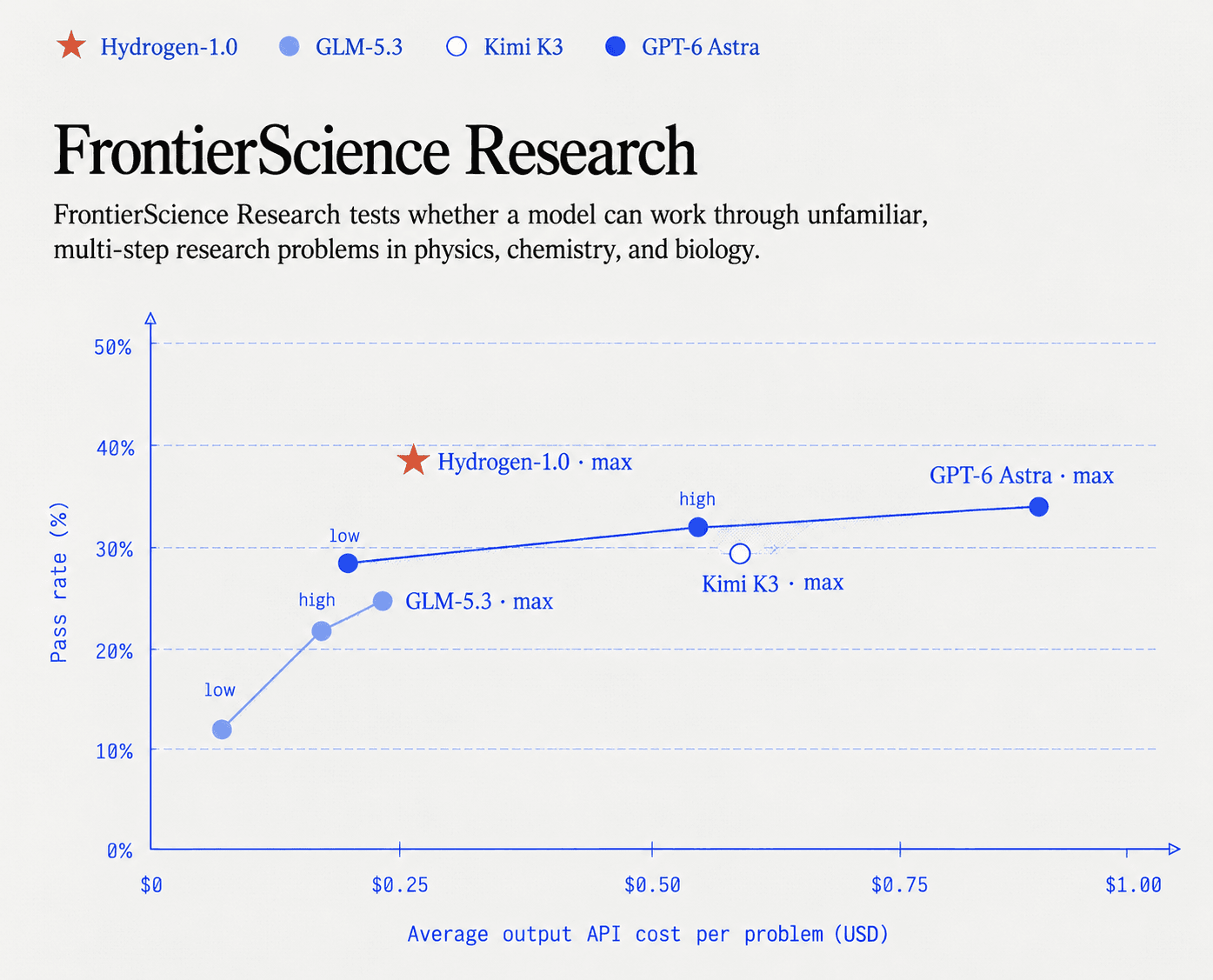
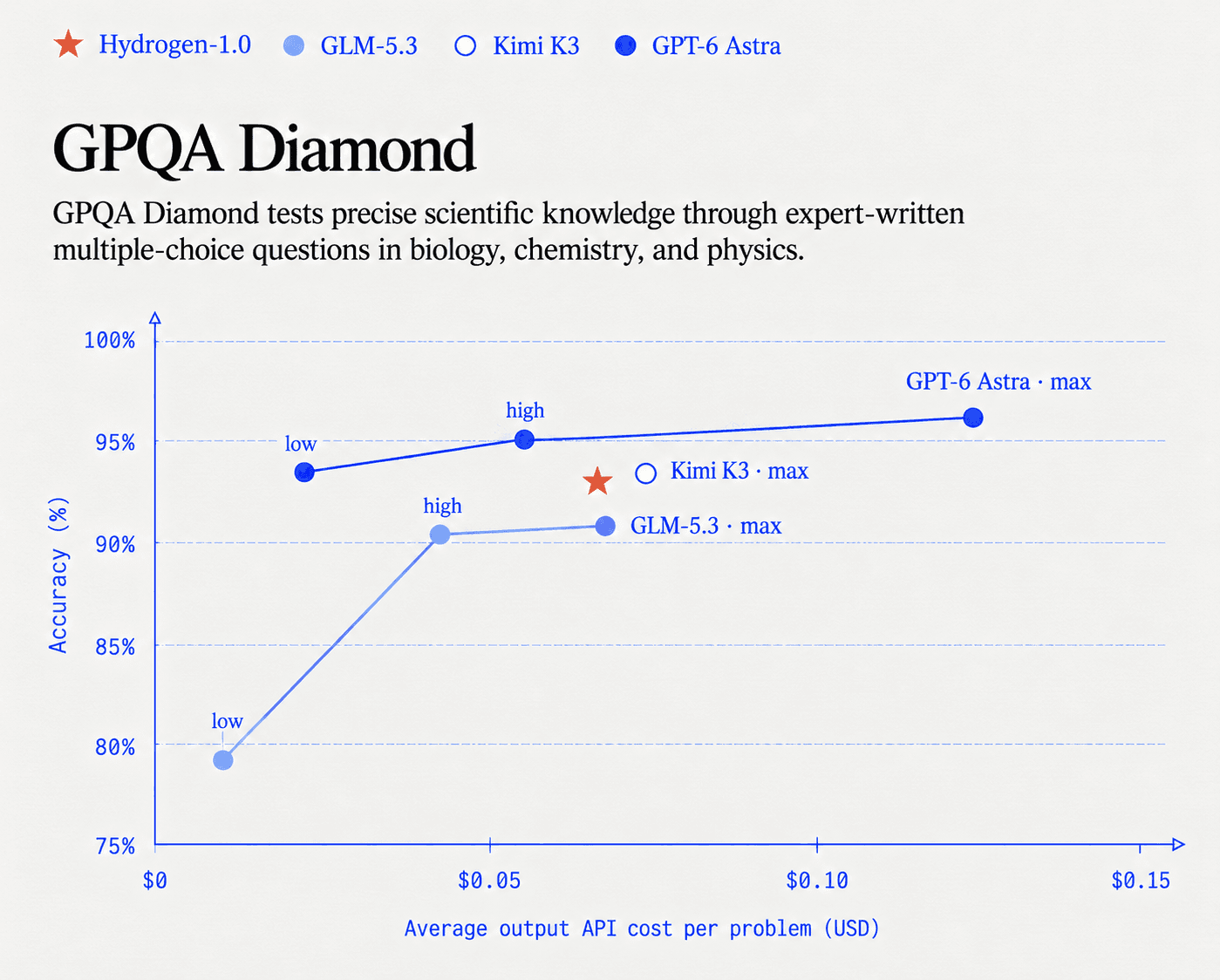
On the public benchmarks FrontierScience-Research and GPQA Diamond, Hydrogen-1.0’s scientific reasoning is clearly stronger than its GLM-5.3 base and overall approaches frontier models, with a wider lead on the harder, open-ended research questions.
FrontierScience-Research FSR tests multi-step reasoning on unfamiliar problems across physics, chemistry, biology, and other fields. Hydrogen-1.0 reaches a 38.3% pass rate, above GPT-6-Astra’s 33.3% and 13.9 percentage points above the GLM-5.3 base.
GPQA Diamond GPQA Diamond is a set of hard multiple-choice science questions written by experts in biology, chemistry, and physics; non-experts struggle with them even with web access, and they test precise command of scientific knowledge. Hydrogen-1.0 reaches 93.0% accuracy, 3 percentage points above the GLM-5.3 base and close to Kimi-K3’s 93.5%.
Solving real research problems
Beyond public benchmarks, the team cares more about whether the model can handle a real research workflow. Materials research typically follows one: first use computation and simulation to understand molecules and materials, then draw up and refine an experimental plan, and after the experiment judge what was actually produced.
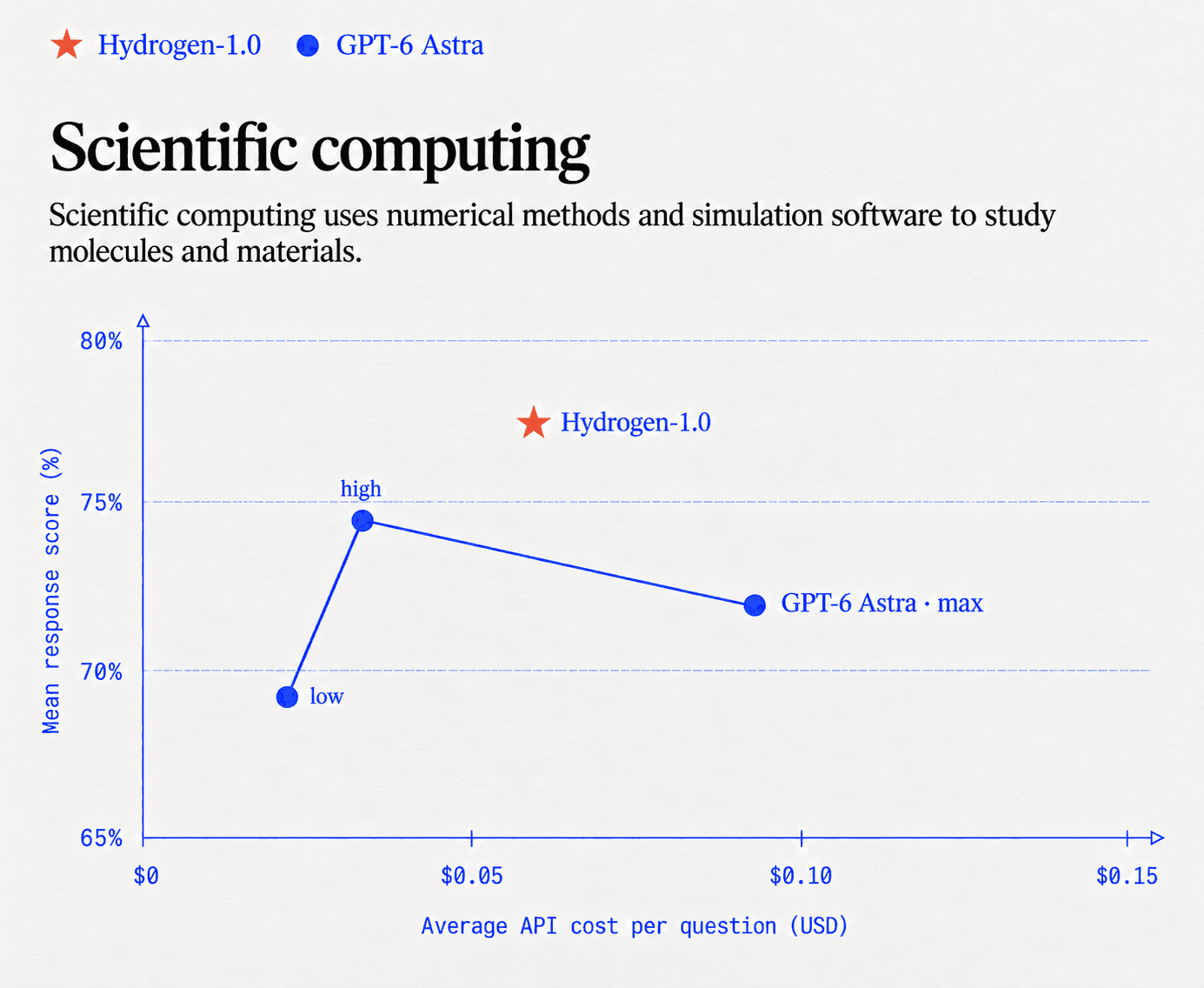
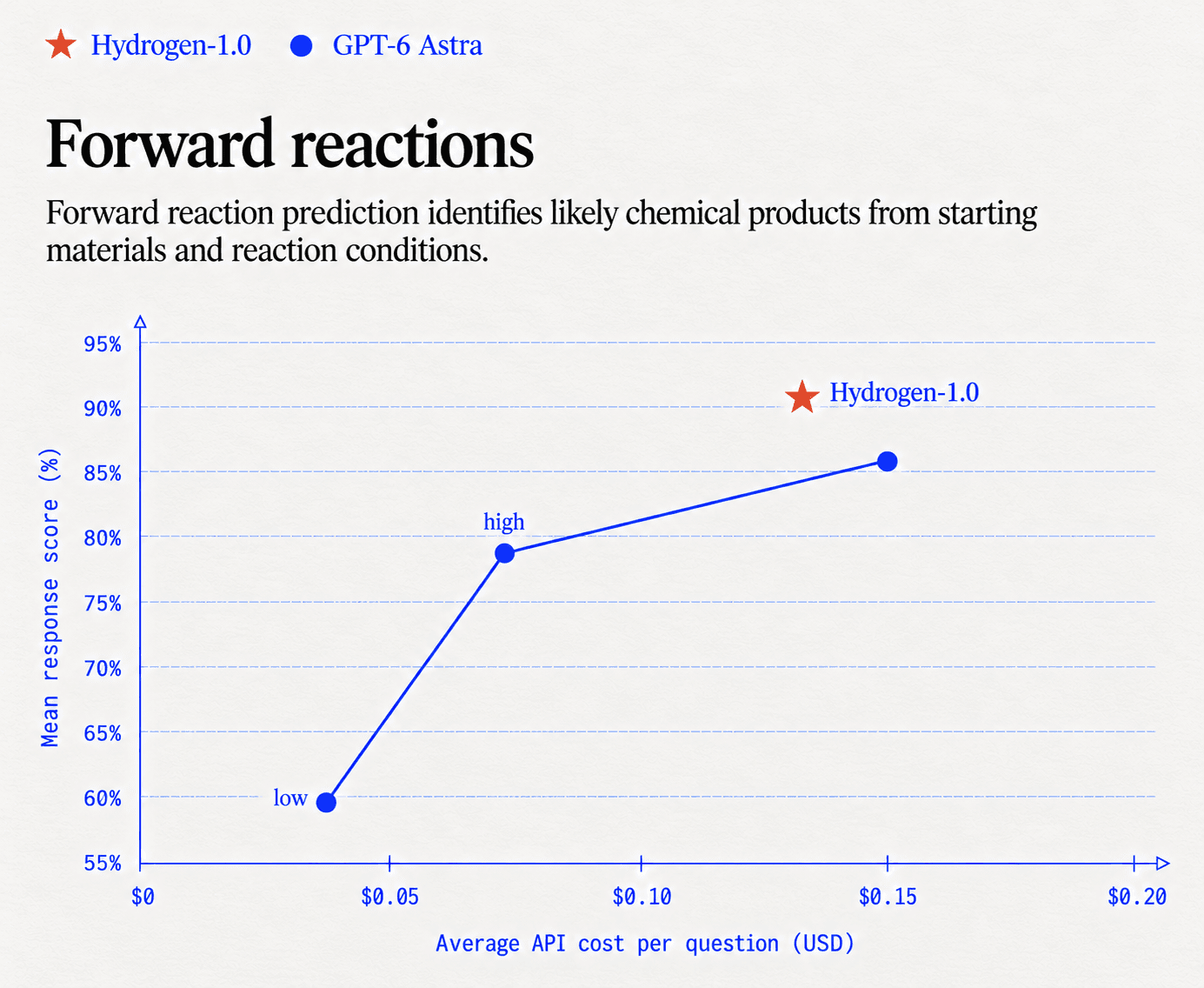
Scientific computing tests the model’s ability to study molecules and materials through computation and simulation; one-step forward reaction prediction tests whether it can judge the likely products from the starting materials and reaction conditions.
On these two tasks, Hydrogen-1.0 scores higher than GPT-6-Astra at all three thinking settings, leading the maximum-thinking Astra by 5.13 and 4.76 percentage points respectively.
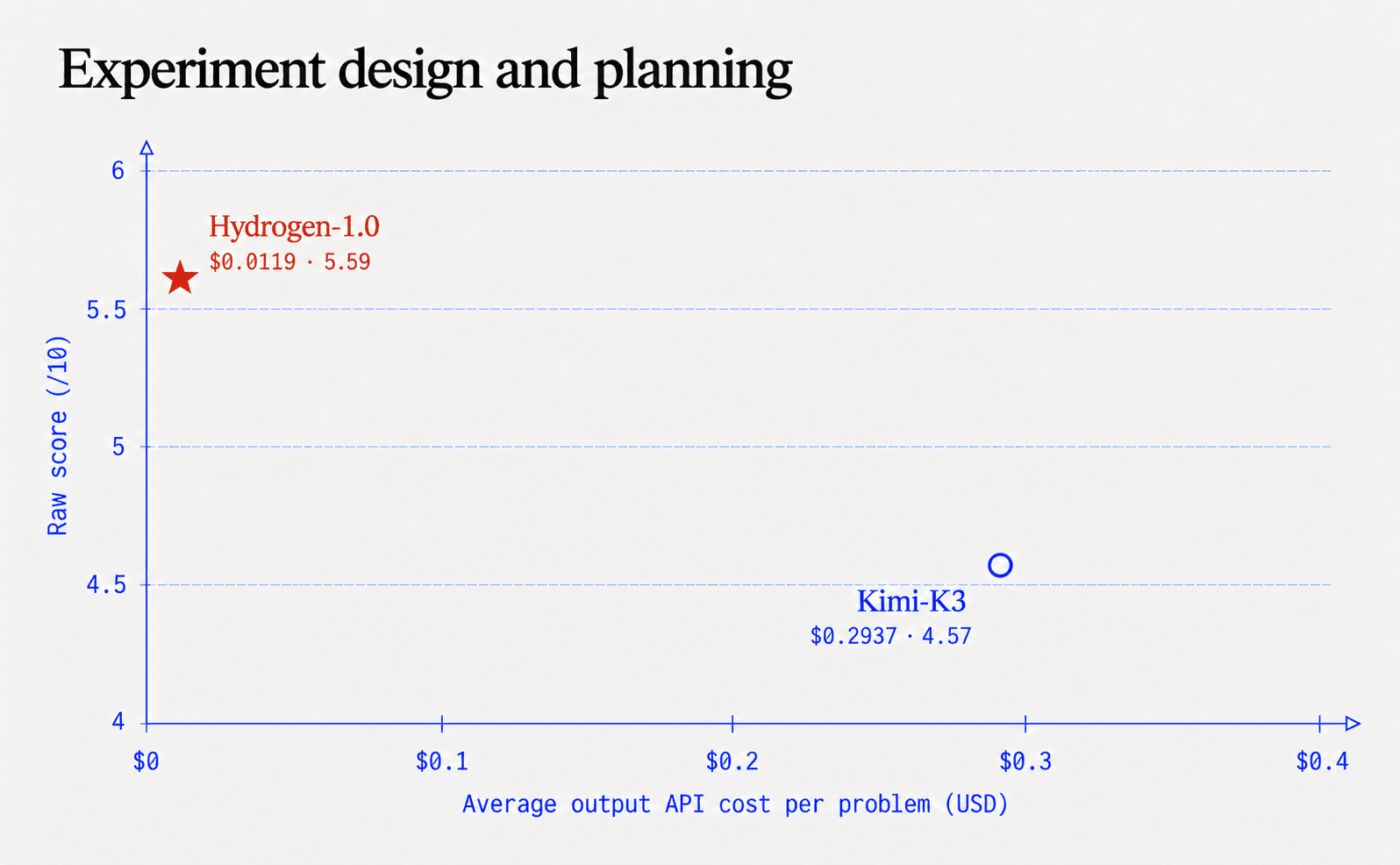
Research also calls for turning a goal into an experimental plan and refining it into concrete steps. The team assessed this with 117 experiment-design and planning questions, scoring the answers under a single rubric (opus-5.5 and GPT-6-Astra declined to answer many of these, so no fair comparison was possible). On a 10-point scale, Hydrogen-1.0 averaged 5.59, above Kimi-K3’s 4.57.
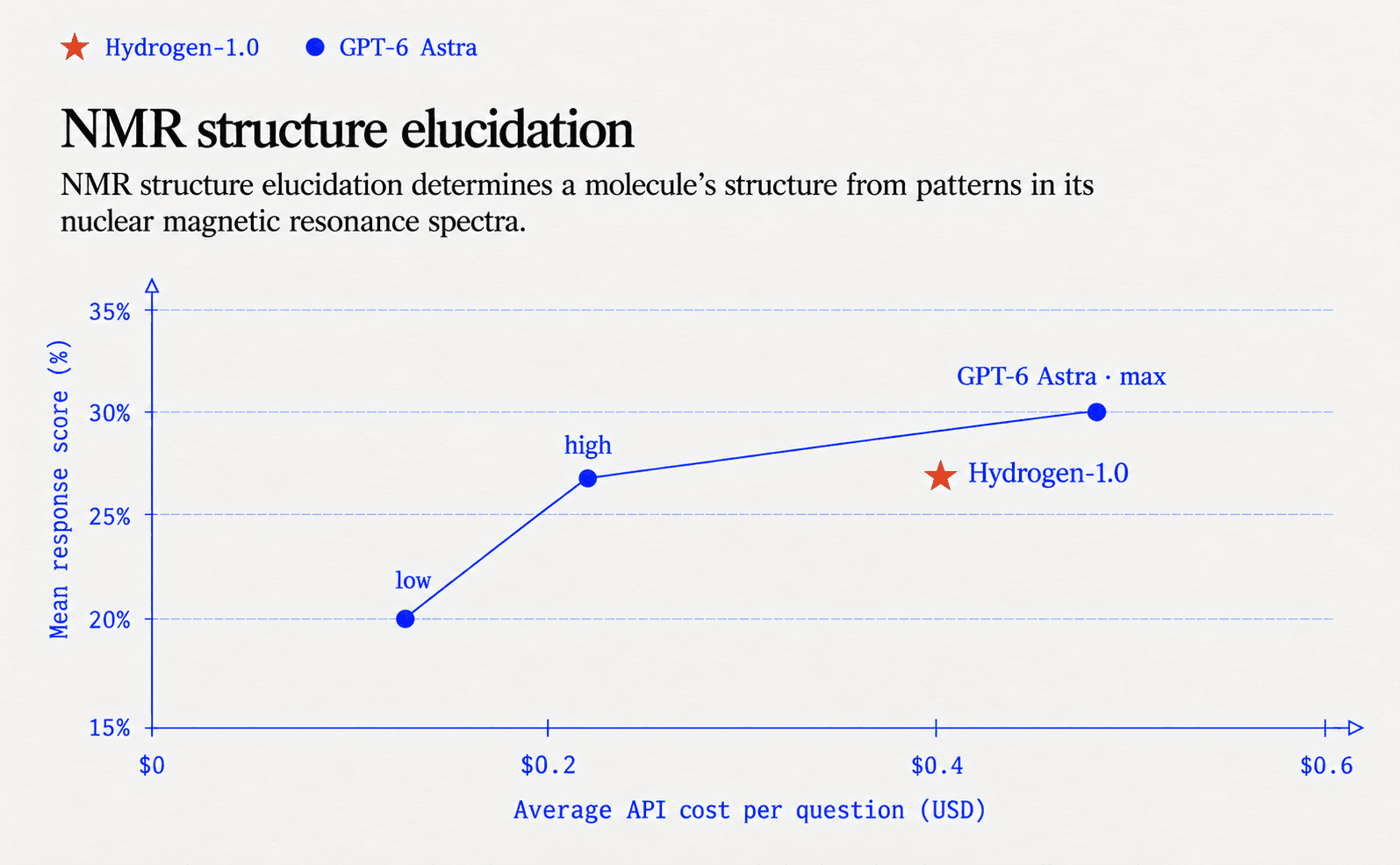
Once an experiment is done, the products still have to be identified. Hydrogen-1.0 can help researchers interpret nuclear magnetic resonance (NMR) spectra and look for clues to identify the compounds. The team tested this with 30 questions; Hydrogen-1.0 came close to the maximum-thinking GPT-6-Astra, trailing by 3.33 points.
Training challenges for a scientific model
In post-training Hydrogen-1.0 from GLM-5.3, Mind Lab worked with Deep Principle to provide engineering support across supervised fine-tuning (SFT), reinforcement learning (RL), data processing, and training infrastructure. SFT supplies task examples of scientific reasoning, experiment planning, protocol design, and results analysis; RL uses feedback to help the model improve its decisions.
To support this, the training system must preserve long reasoning as completely as possible, handle generated trajectories of very different lengths, and provide reliable training signals throughout.
Long-context training
Long scientific reasoning places special demands on both data and infrastructure. A valuable trajectory may pass through computation, checking, failed attempts, and repeated revision before reaching a conclusion; truncating it too early can discard the very steps most worth learning from.
Optimizations such as activation recomputation relieve the memory bottleneck in long-sequence training, meeting the project’s need for 400K-token context training and preserving more complete reasoning trajectories. The existing data pipeline also adds sample filtering, answer-leakage checks, and independent acceptance of rewritten items, so that effective reasoning is retained while synthetic prompts or rewritten content do not reveal answers in advance.
In RL, long trajectories also create a scheduling problem: if every update must wait for all responses to finish generating, the slowest trajectory sets the pace of the whole training step. Asynchronous rollout scheduling, partial rollout, and dynamic sampling let unfinished responses save their progress for later continuation, while training updates are assembled from groups of completed, valid samples.
The system handles the gap between the policy that generated a trajectory and the current training policy through off-policy correction. This cuts the waiting caused by long generations and preserves computation that an interruption would otherwise discard.
Reliable reward signals
Turning these trajectories into learning also requires reliable feedback. Mint Recursive can compute rewards item by item against a scoring rubric, giving the model finer feedback than a single pass/fail outcome. The pipeline also separates “the answer fails the scoring criteria” from “the scoring process failed” or “the evaluation could not complete,” so an infrastructure failure is not treated as a negative sample of poor model performance.
Combined with a penalty that scales with generation length, training provides content feedback while discouraging over-generation as a response nears its context budget.
Training–inference consistency
Training–inference consistency is another focus. Differences between execution engines can shift token probabilities and, in turn, affect RL updates. Training therefore aligns the numerical precision of the training and inference engines, keeping the logprob difference below 1e-5 in the project’s heterogeneous-GPU setup. At the algorithm level, the team uses rollout correction to reweight the training signal via importance sampling, and score centering to suppress systematic gradient drift, further reducing the impact of training–inference mismatch on RL updates.
Infrastructure and evaluation
Supporting infrastructure connects all of this into a full pipeline of training, sampling, and evaluation. Dynamic scheduling lets model updates be reused across different compute resources, and end-to-end tracing helps the team locate failures at each stage. By providing a unified environment, Mint Recursive helps the team align input formats, dialogue templates, and scoring logic, and observe evaluation variance across repeated runs—giving consistent conditions for judging whether the model has changed.